I.
It’s not easy being a Metallica fan—whatever that means.
My unqualified love affair with and
gratitude for the existence of Metallica is relegated to music made during a very short period of time relative to the amount of juice I’ve wrung from it: 1986–1988, when their third and fourth albums,
Master of Puppets and
...And Justice for All, were released.
Lots of people, especially when they’ve been drinking heavily, will tell you that
Puppets and
Justice are bullshit; that the real Metallica albums are the first two,
Kill ’Em All and
Ride the Lightning.
That’s fine with me—they can have ’em.
While I do admire those first couple of albums, they’re a little too uncured for my tastes. The guitars all sound like stupid-colored Jacksons plugged into plastic-Crate half stacks, and when James Hetfield doesn’t sound like he’s singing in the bottom of a well, he sounds like he’s singing through a shitty digital effects processor.
Though
Lightning is certainly better than its overcast production (after all, it does contain
For Whom the Bell Tolls), the vocal-less chunky soup of
The Call of Ktulu is easily rendered negligible by the excellent instrumental tracks on
Puppets and
Justice (
Orion and
To Live is to Die, respectively).
And
Kill ’Em All’s minor masterpieces (
Seek and Destroy,
Jump in the Fire) take a back seat to the best thing about Metallica’s first record—how totally stupid they all look in the
photo on the back cover.
Any fan of early Metallica, if he (or, randomly, she) doesn’t loathe
The Black Album, will at least acknowledge that it pales in comparison to Metallica’s earlier albums. What you’ll never find is the person who likes the first four records (or some variation thereof) and claims that Metallica
just keeps getting better and better. Saying you think that
Master of Puppets is pretty good, but you really like
Load is like saying that you think that Jack Nicholson is pretty good in
Chinatown, but that you prefer him in
Anger Management.
Honestly, and I think this really goes to the heart of the problem I have with post-
Justice Metallica, I see no real difference between the
The Black Album and populist modern country music by Brooks and Dunn, or Kenny Chesney or something—you know, it’s all
built Ford tough.
Metallica’s appeal reached its apex with the release of
The Black Album, which sold 15 million copies. Only people who didn’t like it: fans of the first four Metallica records. So they bolted.
But according to RIAA statistics through 2005: 1996’s
Load has sold 5 million copies; 1997’s
Reload, 3 million; 1998’s
Garage, Inc., 5 million; 1999’s
S&M, 5 million; and 2003’s
St. Anger, 2 million. Do you know anyone buying these records? I don’t. (Besides my friend Chris, who purchased
St. Anger and threw it out of his car window after listening to it on the way home from the record store.)
II.
Used to be the Metallica-coined language of speed metal was, though certainly not universal, at least spoken by kids with different
accents; you were just as likely to see a skater wearing the same
Metallica shirt as your average mullethead.
The only other band I can think of from that time with similar broad cross
genre-ational appeal was Suicidal Tendencies, though their social melding may have been of a more divisive nature. When kids wore Metallica shirts, they were at least advertising the same records, if not lifestyles.
But the first Suicidal Tendencies record was hardcore punk, and the mid-career one-two punch of
Controlled by Hatred/Feel Like Shit...Déjà Vu (itself a compilation of two EPs that, as far as I can tell, were never released separately) and
Lights, Camera, Revolution! were pretty much straight-up speed metal, purportedly due to guitarist Rocky George’s metallic background. When
Hatred and
Revolution dropped, I could have scarcely given a fuck about early Suicidal—but I sure did love those metal records. The skaters probably felt the opposite, preferring the misunderstood youth of
Institutionalized from Suicidal’s self-titled debut to the groovy Satanism of
Hatred’s
Waking the Dead.
So I suppose, then, that former Suicidal bass player Rob Trujillo was a good choice to fill the oafish shoes vacated by Jason Newsted (himself the replacement for original bassist Cliff Burton) when, in 2001, he left to concentrate on his side project with the impossibly stupid name
Echobrain.
Unhappy with letting Echobrain define
embarrassment in his post-Metallica career, Newsted undertook the depressing business of putting the
meta into
metal, banding together with the mötley düde attached to Tommy Lee’s famously generously proportioned wiener and G’nR’s shitty
Use Your Illusions-era jack of all trades Gilby Clarke for the reality TV show/band
Rock Star Supernova. Even though it proved to be the band Lukas Rossi was involved in with the comparatively subtle name—he had previously been in a band called
Cleavage—Rock Star Supernova’s sole album somehow managed to go platinum in Canada.
Newsted, famously the perpetual victim of the band’s relentless frat-boyish hazing, had been unhappy in Metallica for some time. Things, it seems, never really got any better for him from the time he joined the band. According to legend, Hetfield and Ulrich had insisted that producer Flemming Rasmussen bury Newsted’s bass to such a degree that it was inaudible on
...And Justice for All. Consequently, the first time he heard the album’s final mix, Newsted wept.
The Hetfield-Ulrich Dictatorship that rules Metallica appears to be actively vying for the title of disproportionate assholeishness relative to talent, which is currently held by the mean-spirited, leather-faced brothers Van Halen, Eddie and Alex. (VH with David Lee Roth: awesome. Van Halen with anybody else: not so awesome.)
James Hetfield, the taller half of this damaged incorporation, recently told MTV of new bassist Trujillo (he joined in 2003, but
Death Magnetic is the first record he’s played on): "In the studio—and no offense towards Jason—but Rob has already contributed more to this record than Jason did in 14 years.”
Hey—none taken buddy.
And Metallica drummer Lars Ulrich, the shorter half, has said it’s “difficult to praise Rob without insinuating that there was something not great about his predecessor.” Jeez. No wonder dude quit.
Word is
Death Magnetic is a return to Metallica’s speed-enhanced days of yesteryear. But that was the bald-faced lie buzzing around the last one, too, 2003’s
St. Anger, perhaps the worst of Metallica’s career—though it may be worth noting that I have never been able (nor do I ever plan) to listen to it enough to confidently grant it that distinction.
The return-to-form agenda as advanced by Metallica, its publicists and record label appears to be gaining traction fairly effortlessly. As far as I’ve seen, of all of the reviews in major media outlets, only
Pitchfork (predictably) has given it an unfavorable review.
Brian Hiatt, in his four-star (out of five)
review in Rolling Stone gushes:
Just as U2 re-embraced their essential U2-ness post-Pop, this album is Metallica becoming Metallica again—specifically, the epic, speed-obsessed version from the band's template-setting trilogy of mid-Eighties albums: Master of Puppets, Ride the Lightning and, especially, the progged-out ...And Justice for All.
And
Entertainment Weekly’s Chris Willman, in his B+ review writes:
Producer Rick Rubin suggested they quit all that messy evolvin' and get back to the grinding sound of 1986's Master of Puppets. The result might just be patronizing the faithful, but if so, it's some of the thrashiest, most thrilling appeasement you'll hear.
Gee, thanks, Metallica!III.
This whole metal thing is exceptionally tricky. First of all, there are so many different definitions of what heavy metal even is. If you were to tell my friend John, a pretty old-school metal dude (
Judas Priest and Black Sabbath is his aural
meat and potatoes) that Poison was a heavy metal band—he just might punch you in the face. More likely though, he’d shake his head, and just walk away.
The closest I can come to defining heavy metal is: any music that I like that my wife thinks is stupid. And I don’t blame her—any genre of music whose protagonists are oftentimes wearing codpieces is inherently ridiculous. (Ridiculously awesome!)
To paraphrase Blake Schwarzenbach of
Jawbreaker,
one, two, three, four, who’s metal? What’s the score? Alice Cooper? Blue Cheer, White Lion, Whitesnake, Bon Jovi, ELO, Blue Oyster Cult, Black Sabbath, Aerosmith, Guns ’n Roses, Warrant? (No, maybe, yes, yes, no, no, yes, yes, not really, no, yes.) But that’s scarcely the point. This guy may not agree with that guy that Aerosmith is a metal band, but both will easily agree that
Manowar is.
And, certainly, Metallica is—settling, definitively, what’s in a name.
But somewhere along the way, everyone forgot that rock was created as a tool for freaking out parents. Always has been. Or was supposed to be, anyway. From the
negro music reviled by fine, church-going southern whites to the no-good white hooligans with mop tops and toothpicks threatening to undo the social and moral fabric of America. From hippies on acid growing their hair long and pointing the finger at
them for their failings to the mad-grinning, googly-eyed Satanism of heavy metal losers. From the indiscriminate fucking and vacant coke-sniffing of glittery disco dancers to the broken glass and sheer volume of nihilistic punk violence, and the greed and gaucheness of nihilistic gangsta violence.
And that’s it. Now its shuffle or, if you prefer, repeat.
And when top-selling artists advocating actual murder in the real world is greeted with a more-of-the-same style shrug, then maybe things have been taken about as far as they can go.
With gangsta rap moving many units and the grisly and disturbing
CSI and
Law and Order: Special Victims Unit being two of most popular shows on television, shock—outside of real-life horror—is hard to inflict these days. But Iron Maiden and Black Sabbath used to manage quite handily.
IV.
In 1982, the satanic imagery of Iron Maiden’s seminal album
The Number of the Beast may have been frightening, but it has since become comically impotent. It could be that the passage of time has produced a pronounced lack of a Maiden-led satanic uprising. Or it could be the market saturation of all of Maiden’s obscenely priced reissues, as there is nothing faintly Satanic about a
Deluxe Reissue Remastered with Over 5 Hours of Bonus Material! Or it could be that frontman Bruce Dickinson has emerged as the William Shatner of heavy metal, writing genre books and just kind of running around all goofy-like.
For the impotence of Sabbath,
Just Say Ozzy; he was
invited by George Bush to the White House, for fuck’s sake. These days, all these former purveyors of evil seem to renounce or deny their former wicked ways. Black Sabbath bassist Geezer Butler has stated:
[A]ny lyrics that I or Ozzy wrote were actually warnings against Satanism . . . I had a very strict Catholic upbringing, so I read a lot about Satan. But we never, ever promoted Satanism or black magic, we only used it as a reference, and it wasn't our only topic. We wrote a lot of science fiction lyrics, anti-Vietnam war songs, the occult was only dealt with in three or four songs. But people completely misinterpreted them, the way they always do.
I can’t for the life of me figure out how people got the wrong idea.

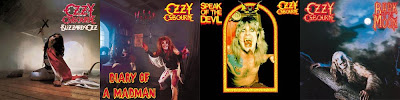
Everybody was scared to death of heavy metal in the ’80s, mostly because everybody in heavy metal wanted to scare people to death. Twisted Sister, who in retrospect seem positively vaudevillian, actually scared people. Even though their music sounded about as sinister as the theme song from
Cheers, they brought the scary by dressing up like murderous trannies and pretended to indiscriminately eat big meat legs of indeterminate origin.
Most people figured that heavy metal was at least as likely to cause American youths to commit suicide as
Advanced Dungeons and Dragons. Whether in horror movies or music, the occult freaked people out, and it was exploited by many a metal band for that particular reason. (But not Black Sabbath or Ozzy.)
And it was never more popular.
Although they came later, Metallica still had that black aura of danger and wickedness swirling around them. They weren’t Satanists. They didn’t play dress-up. And they weren’t funny like
Savatage or
King Diamond or
Helloween. They were decidedly serious, angry. Fast and, most importantly, heavy as
Captain Lou Albano's lunch pail.
For better or worse, the influx of hair metal bands and their incessant power-balladeering waltzed in and replaced a decidedly ugly brand of danger with that of insincere blush-cheeked emoting and sleazy bathroom sex. Soon, even the veteran metal stalwarts were releasing and making videos for their versions of the power ballad, playing ball with the record companies, MTV and most importantly, record buyers. (Scorpions, Dokken, Mötley Crüe, Kiss, Whitesnake, Aerosmith, Def Leppard, etc.)
So I guess we should have seen it coming. 1988’s
…And Justice For All finally spawned a Metallica video, after they had sworn up and down and every which way that they would never make one. The video was for the song
One, which is, I suppose, kind of ballad-like. But rather than being about love, it’s about being a blind, deaf, mute living war casualty with no arms, legs or means of communication, the latter of which he is desperate to regain so that he can let somebody, anybody to
please kill him.
And it was rad at the time, even if now it seems like a premonition of weak things to come. They were pretty beastly looking, as if they could scarcely give a fuck what you think
The best thing about the video for
One has to be watching Newsted’s fingers expertly traveling the fretboard of his bass, purportedly playing notes.
Even if the songs on
The Black Album were a bit prettier, Metallica was still pretty ugly. After
The Black Album—though hugely disappointing, it still had songs about, like, snakes and shit on it—Metallica plunged ass-first into an abyss of boneheaded self-actualization. In
Hero of the Day from 1996's
Load, Hetfield warbles the line: “Excuse me while I tend to how I feel.” That’s a far cry from the cryptic imagery of
Damage, Inc.'s “slamming through, don't fuck with razorback.” (I’m not quite certain what or whom razorback is but, rest assured, I won’t be fucking with it.)
All of a sudden (I had not really paid too much attention for some time) Metallica looked like rock stars instead of underpaid bouncers and town-lockup drunks.
Gone were the signature scumstaches of yore. All of Metallica’s hair was shortened, and teeming with product. Perhaps most shockingly, Kirk Hammet underwent a transformation of Chris Cornell (Cornish?) proportions, suddenly becoming Metallica’s most handsome member. Shortly thereafter, rumors abounded that he was, in fact, gay.
Metallica had become the very thing it actively promoted it would never become: the establishment.
The Thing That Should Not Be. (Sorry.)
At any rate, Metallica lost their sense of danger and, if you ask me, their sense of purpose. And it angered a lot of people. (Especially a lot of drunk ones.) The only other group able to inspire such earnest admiration for its early work and clenched-fist-shaking wrath for the perceived
Et tu, Bruté style betrayal of its fans, is Guns ’n Roses. (Though they,
inarguably, had only one good record.)
V.
Part of the thrill of listening to music of a different era is putting it into its proper context. Early rock and roll is rambunctious only in conjunction with the tumultuous time it appeared—without which it would be defined by PBS Doo-Wop fund-drive specials and Rock ’n Roll Elmo.
David Bowie may be a cuddly bisexual now that we’ve experienced Culture Club and Wham!, but can you imagine that shit
back when it happened? Even Jane’s Addiction was a bit shocking when, in their prescience, they released
Nothing’s Shocking.
So its easy to imagine PTA moms with large, feathered hair flipping out over Accept’s
Balls to the Wall or
Animal (Fuck Like a Beast) by saw-blade-as-penis lunatics W.A.S.P., but when was the last time a metal band inspired fear in the hearts of Americans?
It wasn’t that long ago, actually. In the mid-to-late-’90s, Marilyn Manson caused a veritable shitstorm when he released the albums
Antichrist Superstar and
Mechanical Animals, the latter of which featured a truly creepy rendering of Manson naked, with nippleless breasts, but without genitalia on the
cover. He was also gallivanting around with
he of the Church of Satan and writer of
The Satanic Bible,
Anton LeVey; staging concerts patterned after Nazi Germany rallies; openly advocating the use of hallucinatory drugs; and, most importantly, facilitated outrage and protest from Christian groups all across the country, on every stop of his 1997 tour.
Kudos to him. Amazingly, even with the subtlety of the hydrogen bomb (his name
is Marilyn Manson, for chrssakes), people fell for it. Gloomy and defiant wore it on their faces, because their parents were frightened and outraged by it. (And I suppose that’s part of the appeal of gangsta rap. But there’s something less tangible about drinking someone’s blood out of allegiance to the unholy one than there is to shooting someone in the face because of paper, or some damned thing. Whole different ball of wax.)
Manson reinvented heavy metal imagery, making it shocking and dangerous again, but has since all but lost his edge. Was that the genre’s last gasp?
There are those crazy
Norwegian black metal bands that actually, like, kill each other, but nobody really listens to them. So the only real reason to be scared of a Norwegian black metal band is if you’re in another Norwegian black metal band.
So what is a new, back-to-its-roots Metallica record supposed to convey, anyway? Even if they thrash it out like they did in the old days, what does that mean? Anything? If it isn’t scary or dangerous—and surely anybody who’s seen the film
Some Kind of Monster can attest to the fact that there’s nothing remotely scary or dangerous about eschewing guitar solos from your songs in favor of group therapy and sobriety—then how can it be adequately
kickass?
 1. I saw exactly 16 American films that were released in 2008. The best was Burn After Reading. The worst was Harold and Kumar Escape From Guantanamo Bay. (Oy.) Here's all of them, best to worst, and their star ratings (on a four-star scale):
 2. There were 32 more (strangely, exactly twice the amount I saw) released that I really want to see. They are (in alphabetical order):
 8.Clipse's Hell Hath No Fury, though pretty fucking awesome, is exclusively enjoyed by well-educated white people (especially music critics).
 15. There is an Art of War 2 starring Wesley Snipes.
 18. Home Run Inn makes what is easily the best frozen pizza since the creation of frozen pizza. (Sausage and Pepperoni.)
 21. The best movies I saw last year (for the first time) not released in 2008 were (in no particular order):
 28. The Jerk, Too is only available for purchase in the U.K. Trust me; I checked.